You’re standing outside your own front door, phone at 8% battery, typing “locksmith near me” with cold fingers. The first result looks fine. Nice logo, a 4.9 rating, “from £49”. You call. Forty minutes later a stranger drills your lock and hands you a bill for £600.
That story plays out across London every week, and almost every time it could have been stopped with a few minutes of checking. Stick with this guide to the end, because the last check (the one done on the doorstep) catches the people who pass all the others.
The short answer
Search the company name on Companies House, look it up on the MLA register and Trustpilot, make sure the phone number matches their own website, and get the full price in writing before anyone sets off. Then ask for photo ID at the door. That’s the whole job, and it takes under five minutes.
Why checking matters more with locksmiths than with most trades
Anyone in the UK can call themselves a locksmith. There’s no licence, no register you must join and no exam. A plumber working on gas needs Gas Safe registration. A locksmith opening your front door needs nothing at all.
That gap gets exploited. The Master Locksmiths Association logged more than 300 fraud reports in 2022 alone, and Which? found victims being charged anything from £500 to over £3,000 for a single emergency call-out. In one case reported by the BBC, an elderly couple quoted around £49 ended up with a bill of more than £2,800 after their lock was drilled.
“They left my bank account empty, they took all I had.”
Roberta, a locksmith scam victim, speaking to Tali Ramsey for Which?
The good news: rogue operators are lazy about the details. A fake company rarely survives three or four simple checks, because it can’t fake all of them at once.
The “49-er”: how the bait-and-switch works
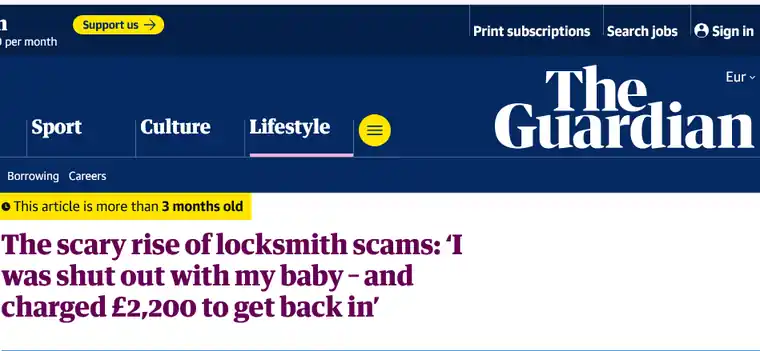
Locksmiths have a name for the most common scam: the 49-er. You’re quoted £45 or £49 on the phone, someone arrives, declares your lock “high security” and says the only way in is to drill. Once the lock is drilled your door can’t be secured, so a new lock, a handle and an internal mechanism get added to the bill. Scams reported to the MLA rose 147% in the first three months of 2026 compared with the same period a year earlier, and complaints about rogue locksmiths grew 66% between 2021 and 2025. The Guardian’s investigation found one London family billed £3,300 for a lockout that a legitimate locksmith would have done for around £190 to £240.
Most of these firms are call centres that list themselves on Google as small local businesses and pay to sit above the organic results. As MLA managing director Steffan George told the Guardian, a top search position “is not an indication of how good a company is”. Google already bans locksmith ads in Germany, Sweden, the Netherlands, Belgium and Spain, and makes locksmiths in the US and Canada pass verification before they can advertise. The UK has no such check yet, so a “Sponsored” label should make you more careful, not less. The same goes for review counters on a company’s own website: a banner claiming thousands of five-star reviews is a plug-in anyone can install.
Two more tactics are worth knowing. Some call centres take your address before giving a price and send someone whether you agreed or not, so if a locksmith turns up and you booked a different firm, ask which company they’re from before they touch the door. And if the price jumps before any drilling starts, paying the call-out fee and sending them away usually costs far less than letting the job go on. Sending a photo of your lock when you call gets you a firmer quote and makes “it’s a high-security lock” much harder to claim on the doorstep.
The 5-minute check, minute by minute
Do these in order. If something fails, stop and call someone else. You don’t need to finish the list to rule a company out.
Search the business name at find-and-update.company-information.service.gov.uk. You want an active company (not “dissolved” or “in liquidation”), a registered office that isn’t a mailbox in another city, and directors whose names you can see. Sole traders won’t appear, which is fine, but then the name and address on their website should match what they tell you on the phone.
Use the “Find a Locksmith” search on locksmiths.co.uk. The Master Locksmiths Association vets and inspects its approved companies, and its members carry an MLA ID card. Never trust the MLA logo on a website by itself. Scam sites copy it constantly, and the MLA asks the public to report misuse.
Search the company on trustpilot.com and spend 90 seconds reading the right reviews. Below you’ll find exactly what to look for, because a high star rating on its own tells you very little.
Compare the number on the Google listing with the one on the company’s own website. Paste the address into Google Maps and look at Street View. A locksmith “based” on a roundabout, a bus stop or a block of flats with forty other businesses registered to it is a warning.
Ask three questions: what is the total price including call-out, VAT and parts, what’s your company name, and who is coming. A real local firm answers all three straight away.
How to read Trustpilot like someone who’s been burned before
A TrustScore is a summary, not proof. Plenty of rogue firms sit on 4.8 stars because they bought or farmed reviews. What separates real companies is the pattern underneath.
Check the profile, not just the stars
Look for “Claimed profile” near the company name, which means a real business set up and manages the page. Check how long the profile has existed. A London locksmith with 900 reviews and a profile that’s four months old should make you suspicious. If Trustpilot has detected fake review activity, it shows a consumer alert banner at the top of the page. Read it if it’s there.
Read the 1-star and 2-star reviews first
Filter by the lowest ratings. You’re not looking for zero complaints (every busy business has some), you’re looking for the same complaint repeating: “price tripled on arrival”, “drilled the lock without asking”, “nobody local, different company turned up”. Then look at the replies. A real firm answers with names, dates and what it did to fix the problem. A fake one either ignores them or pastes the same reply under every review.
Look at when the reviews arrived
Genuine reviews trickle in. Twenty 5-star reviews posted on the same two days, all short and vague (“Great service, highly recommend!”), usually means they were bought. Open a few reviewer profiles too. Accounts with a single review ever written are common in fake batches.
Checked & Vetted, Checkatrade and TrustMark: what each one proves
Trade directories add a second layer, but each one checks different things, and none of them is a legal licence. Here’s how they compare.
| Platform | What it tells you | Best used for |
|---|---|---|
| Checked & Vetted | Members agree to a code of conduct, must be insured and accredited for their work, and most reviews are phone-verified with the customer. | Strong in the North East, where it’s based. Worth a search wherever you are, but London coverage is thin. |
| Checkatrade | Runs its own set of identity, insurance and business checks before listing a trader. | Quick second opinion on reviews in London. |
| TrustMark | Government-endorsed quality scheme. Members are checked on technical skill and trading practice. | Bigger jobs like full door and lock upgrades. |
| MLA | The only body that inspects locksmiths specifically, including their skills and premises. | The most relevant single check for a locksmith. |
| Trustpilot | Open reviews from anyone, plus alerts when fake activity is detected. | Spotting patterns in complaints. |
If a company appears on two of these and Companies House, you’ve done better than most people ever do.
Claims that sound reassuring but prove nothing
- “Police approved”. There’s no police approval scheme for locksmiths. Treat it as a red flag, not a selling point.
- “Local” with a national 0330 or 0844 number. Often a call centre that sells your job to whoever is free. A local firm can tell you which area the person coming is based in.
- “From £39” or “from £49”. The lowest price on the page is rarely the price you pay. Ask for the total, call-out included.
- “DBS checked”. Locksmiths can only get a basic DBS check (standard and enhanced checks aren’t open to the trade), so ask what level was done and for whom.
- Sponsored search results. Paying for an ad says nothing about honesty. Some of the worst operators spend the most on ads.
The doorstep check (the one most people skip)
Everything above happens before anyone arrives. This part happens when they do, and it catches the companies that passed online but send a stranger.
- ☐ The van or the person carries the same company name you checked.
- ☐ They show photo ID, and the name matches who you were told would come.
- ☐ The price they quote at the door matches the price you got on the phone.
- ☐ They try non-destructive entry first and ask before drilling anything.
- ☐ They’ll give you a written invoice with the company name and address on it.
We publish the same checks for ourselves on our verify us section, and our guide prices are on the homepage, so you can compare before you call anyone.
Already been overcharged? What to do next
Ask for an itemised invoice with the company’s name and address before they leave. If they refuse, note the van registration. Then call your bank about a chargeback (or a Section 75 claim if you paid more than £100 by credit card), report it to Action Fraud on 0300 123 2040, and contact Citizens Advice on 0808 223 1133, who pass cases to Trading Standards. If the firm used the MLA logo without being a member, report that to the MLA too.
Doing this quickly matters. Banks and Trading Standards act faster when the job is fresh and the paperwork is clear.
Key takeaways
- Locksmiths aren’t licensed in the UK, so checking is your only protection.
- Companies House, the MLA register and Trustpilot together take under five minutes and rule out most rogue firms.
- On Trustpilot, read the 1-star reviews and the replies, and watch for reviews bunched on the same days.
- Get the full price before anyone sets off, and check ID and the price again at the door.
- Pay by card, and if you’re overcharged, go to your bank, Action Fraud and Citizens Advice the same day.